


SFJ-231- Mobile Helium Leak Detector
Specifications
Details
SFJ-231- Mobile Helium Leak Detector
The helium mass spectrometer leak detector (HMSLD) utilizes helium as a tracer gas due to its unique properties. Small atomic size: Helium can penetrate even the smallest leaks. Inert nature: Helium is chemically stable and non-reactive, ensuring it doesn't damage the components during testing. Low natural abundance: Helium is rare in the atmosphere (~5 ppm), so background interference is minimal, allowing for highly sensitive detection.
Introduction of Helium Leak Detector
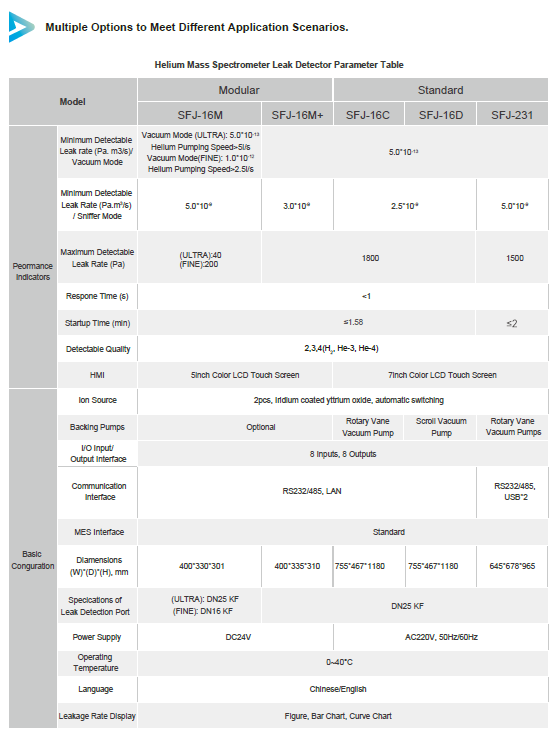
Our Helium Leak Detector is a helium mass spectrometer leak detector specifically designed for helium leak testing. It is a highly sensitive and reliable system that can detect leaks as small as 5*10-9 Pa.m3/s in sniffer mode. With a 7inch color touch screen, users can easily navigate through the user interface that supports both Chinese and English languages. The leak rate display includes numbers, bar charts, and graphs to help visualize the leak detection process.
Technical Specification
| No. | Specifications | Parameters |
| 1 | Minimum Detectable Leak rate (Pa. m3/s) | 5.0*10-13 (Vacuum mode) 5.0*10-9 (Sniffer mode) |
| 2 | Maximum allowable leak detection pressure (Pa) | 1500 |
| 3 | Respone Time (s) | <1 |
| 4 | Startup Time (min) | ≤ 2 |
| 5 | Detectable Quality | 2,3,4(H2, He-3, He-4) |
| 6 | HMI | 7 inch Color LCD Touch Screen |
| 7 | Ion Source | 2pcs, Iridium coated yttrium oxide, automatic switching |
| 8 | Backing Pumps | Rotary Vane Vacuum Pumps |
| 9 | I/O Input/Output Interface | 8 Inputs, 8 Outputs |
| 10 | Communication Interface | RS232/485, USB*2 |
| 11 | MES Interface | Standard |
| 12 | Diamensions (W*D*H-mm) | 645*678*965 |
| 13 | Power Supply | AC220V, 50Hz/60Hz |
| 14 | Operating Temperature | 0~40°C |
| 15 | Language | English/Chinese |
| 16 | Specications of Leak Detection Port | DN25 KF |
Advantages:
1. Harmonic Decoupling Algorithm: Ultra-fast response short response time for shart-up more accurate sealing detection.
2. New structure: Mass spectroment chamber, circuit board, external dimensions, high robustness, low failure rate, easy and efficient operation and maintenance.
3. Stable input and Ecient output: Equipped with RS232, RS485 and USB communication interfaces, it is able to work stably under the worst working conditions after various extreme tests, digital and anaing outputs are availble to meet the needs of remote operating system integration.
4. Rapid and accurate detection of helium or hydrogen by vacuum helium injection method, sniffer method, helium hood method, back pressure method and other detection methods, it is suitable for industrial leak detection in various high requirements and harsh environments.
5. Magnetic Mass Spectrometry (MMS) principle with high detection accuracy and wide
detection range
Application of Helium Mass Spectrometer Leak Detectors in the Lithium Battery Industry
Helium mass spectrometer leak detectors are highly sensitive instruments widely used in industries where leak detection is critical, including the lithium battery industry. Lithium-ion batteries are extensively used in electric vehicles, consumer electronics, and renewable energy storage systems. Ensuring the hermetic sealing and leak-tightness of lithium battery components is essential for safety, performance, and longevity. Helium mass spectrometer leak detection plays a key role in achieving these requirements.
1. Leak Testing of Battery Cells
Lithium-ion battery cells must be hermetically sealed to prevent the ingress of air and moisture, which can lead to chemical reactions, degradation, and safety hazards (e.g., thermal runaway or explosions).
Helium leak detectors are used during the manufacturing process to test the seal integrity of battery cells. The cells are pressurized with helium, and any escaping helium is detected by the mass spectrometer, identifying leaks with high precision.
2. Leak Testing of Battery Packs and Modules
A battery pack consists of multiple cells enclosed in a protective casing. The casing must be leak-tight to protect the cells from environmental exposure (e.g., water or dust ingress).
Helium leak detection ensures the enclosure's integrity by testing for leaks in the seams, joints, or connectors of the pack.
3. Electrolyte Filling Systems
During the manufacturing process, lithium-ion battery cells are filled with a liquid electrolyte that facilitates ion transport. Leak detection is crucial during and after this step to ensure that the filled electrolyte does not leak out, which would compromise performance and safety.
Helium leak detectors are used to confirm the leak-tightness of the cell after electrolyte filling and sealing.
4. Testing of Cooling Systems in EV Battery Packs
Electric vehicle (EV) battery packs often include liquid cooling systems to maintain optimal operating temperatures. These cooling systems must be leak-tight to prevent coolant from leaking into the battery cells and causing short circuits or other damage.
Helium mass spectrometers are used to test the cooling channels and ensure no leaks are present.
5. Quality Assurance and Process Control
In large-scale production of lithium-ion batteries, helium leak detectors are integrated into automated production lines for continuous quality monitoring. This ensures that every battery cell, module, and pack meets the required standards for leak-tightness.
Helium testing is often used in conjunction with vacuum chambers or sniffer probes, depending on the specific part being tested.
Testing Methods in Lithium Battery Applications
1. Vacuum Method
The test object is placed in a vacuum chamber and pressurized with helium. Any helium escaping through leaks is detected by the mass spectrometer.
This method is highly sensitive and suitable for testing battery cells and small modules.
2. Sniffer Method
A sniffer probe connected to the helium mass spectrometer is used to detect helium leaks at specific locations, such as welds, joints, or seals.
This method is practical for testing large battery packs or localized leak detection.
3. Bombing Method
The test object is pressurized with helium gas for a specific period (the "bombing" phase). If leaks are present, helium will penetrate the object. Afterward, the object is evacuated, and helium escaping from leaks is detected.
This method is used when direct pressurization is not feasible.
-
Available in Indonesia Philippines Vietnam Singapore Thailand Malaysia Brunei Cambodia Laos Myanmar .
Contact : sales@hexoind.com
View more about SFJ-231- Mobile Helium Leak Detector on main site